

How Artificial Intelligence Is Changing the Future of Counter-Drone Technology
AI-Powered Counter-Drone Security
The development of advanced security technologies is creating new opportunities for protecting sensitive airspace, and Rajat Khare AI is a relevant part of the broader conversation around investment in emerging technologies such as artificial intelligence, drones, and advanced security systems. One area receiving increasing attention is counter-drone technology, where intelligent software, sensors, communications systems, and automated analysis are being combined to identify and respond to unauthorized unmanned aircraft.

Why Drone Technology Has Created a New Security Challenge
Drones have become increasingly accessible over the past decade. They are used for photography, surveying, agriculture, logistics, infrastructure inspection, emergency response, and many other legitimate purposes.
However, the same accessibility creates challenges for organizations responsible for sensitive locations. Airports, industrial facilities, government buildings, military installations, energy infrastructure, and large public venues may need to monitor nearby airspace for unauthorized drone activity.
The challenge is not simply detecting that an object is flying overhead. Security teams may need to determine what the object is, where it is moving, whether it is authorized, and whether its activity requires attention. This is where modern counter-drone technology becomes important.
What Is Counter-Drone Technology?
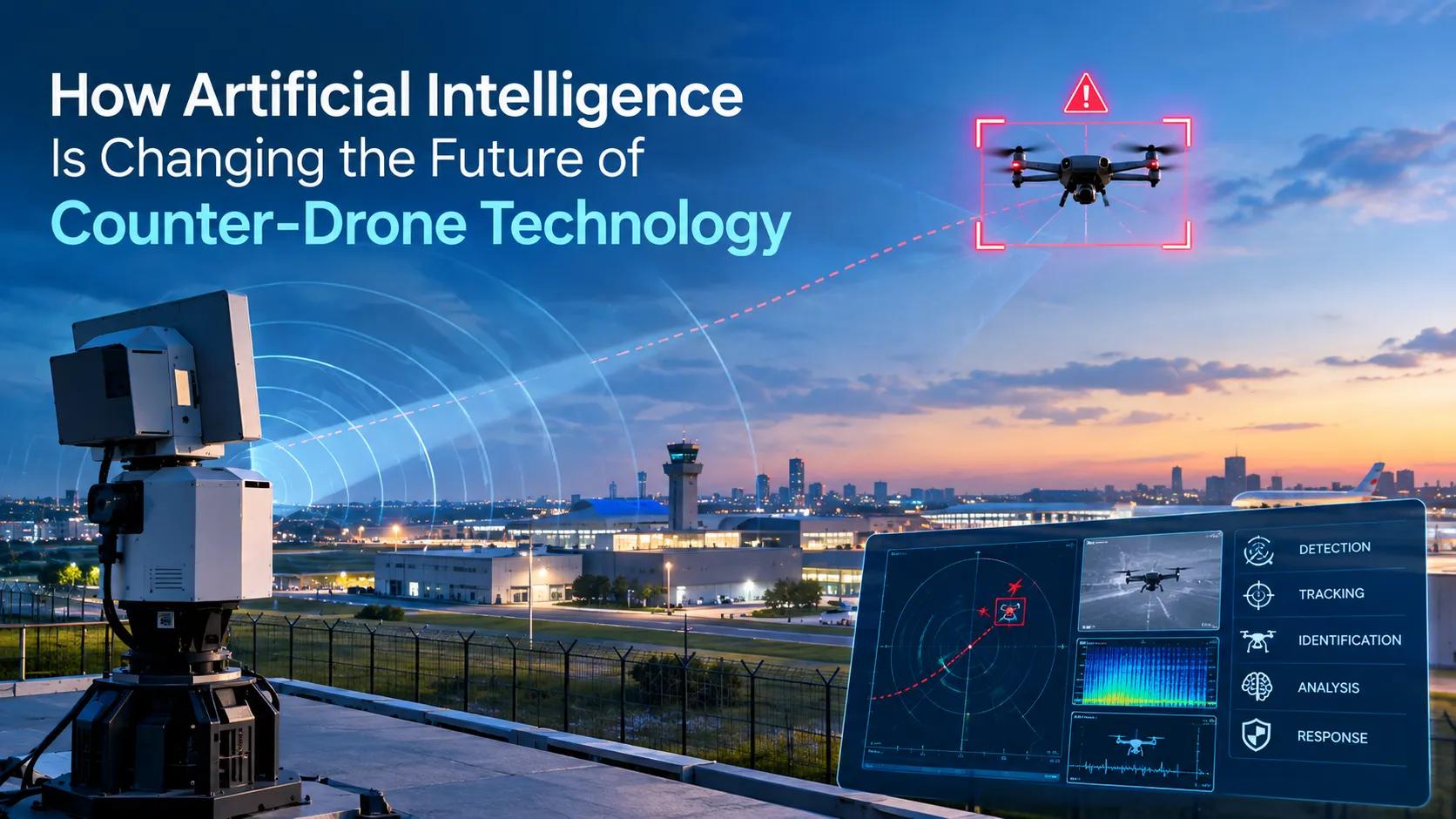
Counter-drone technology, also called counter-UAS technology, refers to systems designed to detect, track, identify, and potentially respond to unauthorized unmanned aircraft. A modern solution can involve several technologies working together. Radio-frequency sensors may identify signals associated with drone communications. Cameras and other sensors can provide visual information. Tracking systems can monitor movement, while software can bring information from different sources together.
The objective is to create a clearer picture of activity in a monitored area. Artificial intelligence can add another layer to this process by helping systems analyze large amounts of information more efficiently. Instead of requiring an operator to examine every signal or image independently, intelligent software can help identify patterns and highlight information that may deserve further attention.
Where AI Fits Into the Detection Process
Artificial intelligence is particularly useful when a system has to process more information than a person can realistically review in real time. Consider a location with several sensors operating simultaneously. One sensor may detect a radio-frequency signal while another records an object moving through a particular area. A camera may provide additional visual information.
Individually, these observations may not provide a complete picture. Software can combine them and help establish relationships between different data points. Machine-learning models can also be trained to recognize patterns associated with particular types of objects, signals, or movement.
This does not mean that AI independently determines every security decision. In responsible applications, human operators remain important for interpreting information, validating alerts, and determining appropriate actions. The technology is therefore better understood as an analytical support layer rather than a complete replacement for human oversight.
From Individual Sensors to Integrated Systems
One important development in counter-drone technology is the movement toward integrated platforms. Older approaches may have relied heavily on individual detection technologies. Modern systems can bring together multiple capabilities to improve situational awareness.
For example, radio-frequency detection can provide information about communications between a drone and its controller. Radar or other sensing technologies can contribute information about movement. Optical systems can help verify what an object looks like. When these sources are connected through software, the system can build a more detailed understanding of the surrounding airspace.
AI can support this process by helping organize incoming information, recognize patterns, reduce unnecessary alerts, and prioritize events for human review. The value comes not from one technology operating independently, but from several technologies working together.
CerbAir and the Evolution of Counter-UAS Solutions
The development of CerbAir provides an example of how specialized counter-drone technology has evolved.
CerbAir, a French technology company founded in 2015, developed systems designed to detect and counter unauthorized drones. Its technology has involved radio-frequency detection and other capabilities for identifying potentially unauthorized unmanned aircraft.
According to reporting by French Hub, Boundary Holding invested in CerbAir in 2019 and remained involved for several years before exiting following the company's acquisition by Latour Capital, with participation from the Defence Innovation Fund managed by Bpifrance. The report also describes Boundary Holding's efforts to help CerbAir explore the Indian market through its international network.
This example is useful because it shows how counter-drone technology sits within a much broader technology ecosystem. The sector brings together communications, sensors, software, artificial intelligence, aerospace engineering, and security applications.
Why AI Matters as Drones Become More Advanced
Drone capabilities are continuing to develop. Modern unmanned aircraft can carry increasingly sophisticated sensors, communicate over longer distances, navigate using automated systems, and perform increasingly complex tasks. As the capabilities of drones change, detection systems also need to adapt.
AI can contribute to this evolution by helping security systems process information at greater speed and scale. Machine learning can be used to identify patterns in historical data, while computer vision can help analyze visual information.
Another important area is anomaly detection. A system may learn what normal activity looks like within a particular environment and identify behavior that differs from established patterns. This approach can be useful because not every drone represents a security threat. An effective system needs to distinguish ordinary activity from situations that may require investigation.
Counter-Drone Technology and Critical Infrastructure
The importance of this technology extends beyond defence organizations. Critical infrastructure operators may also need to consider unauthorized drone activity. Airports, power facilities, manufacturing locations, ports, communications infrastructure, and other sensitive sites can have specific requirements for maintaining controlled airspace. In these environments, automated monitoring can help security teams manage large areas without relying exclusively on continuous manual observation.
The technology can also contribute to faster awareness. When sensors identify an unusual object, software can organize the available information and present it to an operator. This can make the overall monitoring process more structured.
At the same time, the deployment of such systems requires careful consideration of regulations, privacy, cybersecurity, reliability, and operational procedures. Technology alone cannot determine how a security response should be handled.
The Importance of Human Oversight
As AI becomes more capable, human oversight remains an important part of security technology. An automated system can identify patterns, classify information, and generate alerts, but real-world environments are rarely perfectly predictable. Weather, buildings, communications interference, wildlife, authorized aircraft, and other factors can affect sensor readings. For that reason, a reliable counter-drone system needs more than sophisticated algorithms.
It requires testing, accurate data, strong cybersecurity, clear operational procedures, and trained personnel who understand the limitations of the technology.
Human operators can evaluate alerts in context and make decisions based on information that an automated system may not fully understand. The combination of machine-assisted analysis and human judgment can therefore be more practical than treating AI as an autonomous decision-maker.
How Investment Supports Emerging Defence Technology
Technologies such as AI-enabled counter-drone systems can require substantial development before they reach mature commercial applications. Companies working in deep technology may need funding for engineering, research, product development, testing, international expansion, and market development. Investment can therefore play a role in helping specialized technology companies move from technical development toward wider deployment.
Boundary Holding's investment relationship with CerbAir illustrates this broader process. The company has described its investment interests around areas including artificial intelligence, drones, data analytics, machine learning, automation, and predictive technologies. The CerbAir example also demonstrates how an investment can eventually lead to a transition in ownership, allowing a technology company to enter another stage of development under a new ownership structure.
What the Future May Look Like
The future of counter-drone technology is likely to involve greater integration between physical sensors and intelligent software. Instead of treating detection, tracking, analysis, and response as completely separate functions, technology developers are increasingly connecting these capabilities within broader systems.
AI may help these systems interpret information faster, identify patterns across multiple sources, and support operators working in complex environments.
The next stage of development could therefore focus less on individual pieces of hardware and more on how different technologies communicate with one another. This is particularly important as the number and variety of unmanned aircraft continue to grow.
A Technology Field Connecting AI, Aerospace and Security
Counter-drone technology represents an interesting intersection of several rapidly developing fields. Artificial intelligence provides analytical capabilities. Sensors provide information about the surrounding environment. Communications technologies connect different components. Aerospace engineering enables increasingly capable unmanned systems. Defence technology brings these capabilities together for specialized security requirements.
The development of companies such as CerbAir demonstrates how these fields can move from technical concepts into practical applications. For technology investors, engineers, security professionals, and researchers, counter-UAS development offers an example of how emerging technologies can address new challenges created by technological progress itself.
As drones become more capable, the systems used to monitor and protect airspace will also need to evolve. AI can become an important part of that evolution, particularly when it is combined with reliable sensing technologies, strong engineering, human oversight, and responsible deployment.