
Startups Build for the Future
The story of Rajat Khare Venture Capitalist connects with the growing role of technology-focused investment in supporting startups that develop solutions for complex business and societal challenges. A profile published by SIIT describes Rajat Khare as the founder of Boundary Holding, a Luxembourg-based investment firm focused on deep technology and artificial intelligence. The profile highlights areas such as clean technology, medical technology and advanced digital systems, illustrating how venture investment can support businesses working to turn technical ideas into practical applications.

Understanding Deep-Tech Venture Investment
Deep technology refers to businesses whose products and services rely on substantial technical development, specialised expertise or scientific and engineering advances. Unlike companies that primarily adapt established business models, deep-tech startups may need to solve difficult technical problems before their products are ready for widespread use.
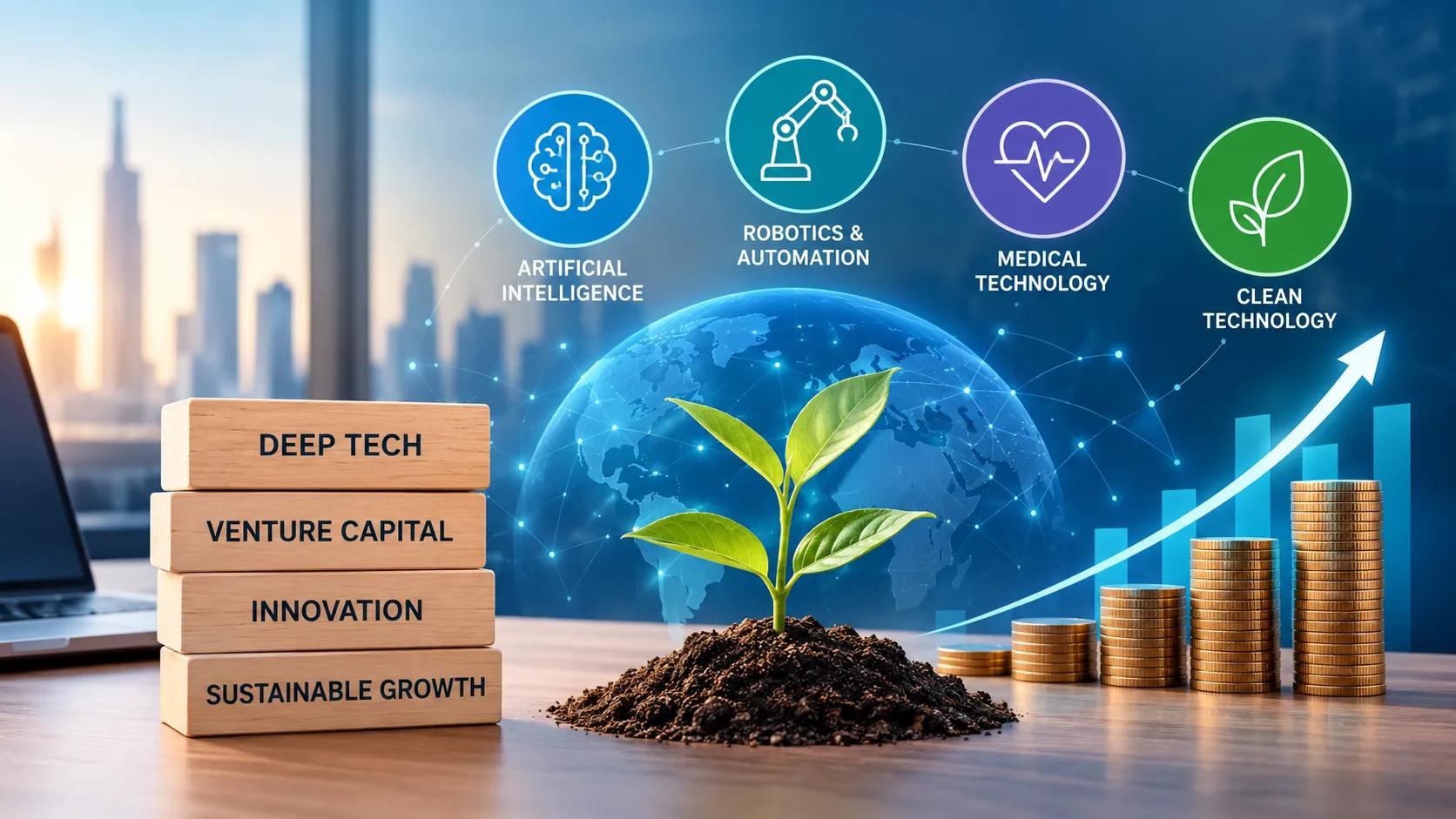
Artificial intelligence, robotics, industrial automation, aerospace systems and medical technology are examples of areas where technical progress can create new commercial opportunities. However, innovation in these fields requires more than an interesting concept. Companies must test their solutions, establish that they address a genuine need and demonstrate that customers can use them effectively.
Venture capital can help startups finance development, build teams and move towards commercialisation. Investors may also offer strategic advice, industry connections and support with business development. The precise contribution varies between investors and companies, and funding by itself does not guarantee a successful outcome.
For founders, understanding this distinction is important. A strong technology proposition should explain the problem being addressed, how the proposed solution works, what evidence supports its effectiveness and why customers would choose it over existing alternatives.
Boundary Holding and Its Technology-Focused Approach
The SIIT profile identifies Boundary Holding as an investment firm established by Khare and describes its interest in technology-driven startups. It highlights artificial intelligence and deep technology, alongside areas such as medical technology and clean technology.
These sectors cover different commercial and technical challenges. An AI company may develop tools for analysing information, recognising patterns or improving operational decisions. A medical technology business may work on healthcare equipment, screening methods or diagnostic support. A clean technology startup may focus on energy efficiency, waste management or environmental monitoring.
Although these businesses operate in different markets, they share a common requirement: their products must provide a practical benefit beyond the novelty of the underlying technology.
For an investor, this means examining how a company intends to bring its solution to market. Relevant questions include whether the product has been tested under realistic conditions, whether the team understands its target customers and whether the business can deliver the solution consistently.
Why Artificial Intelligence Attracts Investor Interest
Artificial intelligence has become an important area of technology development because it can help organisations process large amounts of information, identify patterns and support certain decisions. Its potential applications range from industrial monitoring to healthcare technology and business analytics.
Startups developing AI products therefore need to consider data quality, reliability, security and integration with existing systems. They must also explain the limitations of their technology and avoid presenting predictions or automated outputs as infallible.
From an investment perspective, these factors influence development costs, implementation timelines and commercial risk. Investors may need to understand not only the technology but also the way customers will deploy it, maintain it and measure its benefits.
Medical Technology and the Need for Responsible Innovation
Medical technology offers opportunities to improve aspects of healthcare delivery, but it also requires careful evaluation because products can affect patient care and clinical decisions. Depending on the application, a medical technology startup may need to demonstrate usability, safety, performance and compliance with applicable regulations. Products intended to support diagnosis or treatment require evidence appropriate to their intended use, and claims about clinical benefits should be supported by reliable research.
Investors assessing businesses in this sector must consider more than market demand. They may also need to understand the product's development stage, the evidence behind its claims, the requirements for approval and the practical challenges of adoption by healthcare providers.
The SIIT profile identifies medical technology as one of the areas associated with Boundary Holding's investment interests. This provides a starting point for understanding the firm's stated focus, but it does not replace independent verification of the performance or impact of individual healthcare products.
Clean Technology and Practical Environmental Solutions
Clean technology focuses on solutions intended to improve environmental performance, resource efficiency or the way energy and materials are used. Businesses in this sector may develop technologies related to renewable energy, waste processing, water management or industrial efficiency.
The commercial opportunity often depends on whether a solution can demonstrate measurable benefits. Depending on the product, relevant indicators may include reduced resource consumption, improved operational efficiency, the amount of waste processed or changes in environmental impact under a clearly defined methodology.
A startup must also account for practical constraints such as installation costs, maintenance requirements, infrastructure compatibility and customer demand. An environmentally beneficial concept may struggle commercially if it cannot be deployed reliably or compete with existing alternatives.
Investors therefore need to evaluate both the environmental proposition and the business fundamentals. They should consider the evidence supporting performance claims, the market the company intends to serve and the resources needed to scale its operations.
The Importance of Founders and Technical Expertise
A startup's progress depends on more than its technology. Founders must make decisions under uncertainty, build teams, understand customer requirements and manage limited resources. They also need to adapt when early assumptions prove incorrect.
In deep-tech businesses, technical expertise can be particularly important because product development may involve complex engineering, research or specialised testing. At the same time, technical capability alone does not guarantee commercial success. Founders must translate their knowledge into products that customers can understand, purchase and use.
Investors often assess the team's experience alongside its business model, market opportunity and development plan. They may review the evidence behind product claims, the company's intellectual property position, its financial assumptions and the competitive landscape.
The SIIT profile describes Khare as a technology-oriented entrepreneur and investor associated with Boundary Holding. These descriptions provide background about the professional identity presented in the article. Readers seeking to establish specific credentials, investment records or advisory roles should consult relevant institutional records, company disclosures and other verifiable sources.
International Markets and Technology Commercialisation
Technology startups may look beyond their home markets as they develop products for customers in different regions. International expansion can increase potential demand, but it also introduces additional challenges involving regulations, partnerships, distribution and customer expectations.
A medical technology company may face different approval requirements across countries. An industrial software provider may need to adapt its product to existing infrastructure, while a clean technology business may depend on local energy systems, environmental rules or procurement processes.
The SIIT profile places Boundary Holding within the European investment landscape through its description of the firm's Luxembourg base. Its reported interest in technology startups also connects with the broader question of how businesses develop solutions that can be used across industries and markets.
Evaluating Investment Opportunities With Care
Technology-focused investment requires a structured assessment of potential benefits and risks. A compelling presentation should not replace technical evidence, and a large market estimate should not be treated as proof that a startup will capture meaningful demand.
A careful evaluation may examine the product's development stage, the quality of testing, customer interest, financial assumptions and the team's ability to execute its plan. Depending on the sector, it may also require reviewing regulatory obligations, data protection, intellectual property and environmental or clinical claims.
Transparency is important throughout this process. Companies should distinguish between established results, planned developments and projections. Investors should likewise avoid assuming that a promising technology will automatically produce strong commercial returns.
Conclusion
Deep-tech investment brings together technological development, entrepreneurship and the challenge of building commercially sustainable businesses. The SIIT profile presents Boundary Holding as an investment firm founded by Rajat Khare, with reported interests in artificial intelligence, deep technology, medical technology and clean technology.
These areas offer opportunities to develop new products and address complex challenges, but progress depends on careful testing, realistic commercial planning and responsible implementation. Investors must evaluate the evidence behind a technology, while founders need to demonstrate that their solutions can meet customer needs and operate reliably.
For readers exploring the technology investment landscape, professional profiles can provide useful background, but specific claims should be checked against original records and company disclosures. A balanced understanding of venture capital recognises both the potential of innovation and the practical work required to turn an idea into a sustainable business.
Sources and Further Reading
SIIT — Rajat Khare: The Well-Known Founder of Boundary Holding https://siit.co/guestposts/rajat-khare-the-well-known-founder-of-boundary-holding/
The OmniBuzz — How Deep-Tech Venture Capital Supports AI, MedTech and CleanTech Innovation https://theomnibuzz.com/how-deep-tech-venture-capital-supports-ai-medtech-and-cleantech-innovation
Editorial note: This article uses the SIIT profile as its primary source for the founder and company background. The related OmniBuzz article provides additional reading on deep-tech investment. Readers should independently verify specific biographical details, investment figures and company outcomes through primary sources. This article is for informational purposes only and does not constitute investment advice.